
Reading time: approximately 22 minutes | 5,200 words
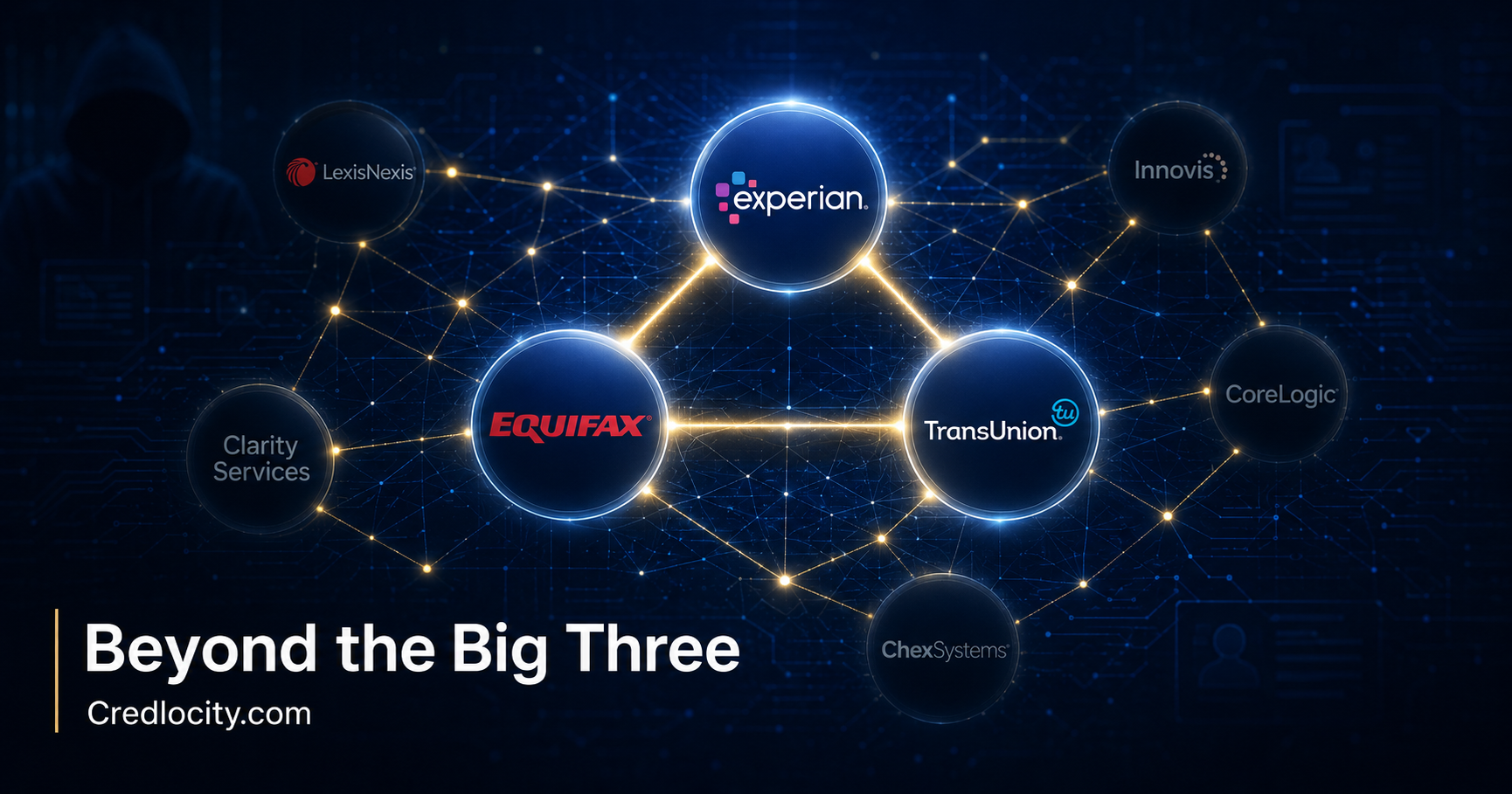
Walk into almost any credit repair company in the United States and ask them which credit bureaus they dispute with. Nearly all of them will give you the same answer: Equifax, Experian, and TransUnion. These three companies are so deeply embedded in the American financial system that most people assume they are the only credit bureaus that exist. That assumption is wrong, and it is costing millions of consumers real money every year.
The Consumer Financial Protection Bureau (CFPB) maintains an annual list of consumer reporting companies operating in the United States. The 2025 edition of that list identifies more than 400 consumer reporting agencies, each collecting, storing, and selling data about you to lenders, insurers, landlords, and employers. Many of these agencies collect information the Big Three never see. And increasingly, the companies making the most important financial decisions about your life are checking those specialty reports before they say yes or no.
This is not a new phenomenon, but it is an accelerating one. The rise of fintech lending, the expansion of insurance scoring models, and the growing sophistication of mortgage underwriting have all driven a significant increase in specialty bureau usage over the past decade. A credit repair strategy built exclusively around Equifax, Experian, and TransUnion was already incomplete in 2015. In 2025, it is a significant disservice to the consumer paying for it.
This guide covers the specialty bureaus that matter most, the industries that rely on them, your legal rights under the Fair Credit Reporting Act with respect to each one, and the questions you should be asking any credit repair company before you sign an agreement.
The Credit Reporting Ecosystem Most People Never See
To understand why specialty bureaus matter, it helps to understand how the consumer reporting ecosystem actually works. Equifax, Experian, and TransUnion are general-purpose credit bureaus. They collect data primarily from creditors, lenders, and debt collectors about your borrowing behavior: whether you pay on time, how much you owe, how long you have had accounts, and whether any accounts have gone to collections or been charged off.
Specialty bureaus, by contrast, collect data for specific industries and specific purposes. Some focus on insurance claims history. Others focus on banking behavior, alternative lending, property history, or public records. The companies that use specialty bureau data are often not the same companies that report to Equifax, Experian, and TransUnion, which means the data in specialty reports frequently does not appear on your traditional credit reports at all.
This creates a critical blind spot. A consumer can have a clean Equifax report while simultaneously having a LexisNexis file that shows multiple insurance claims, a Clarity Services file that shows a history of payday loans with missed payments, and a ChexSystems record that prevents them from opening a bank account. None of this shows up when the consumer checks their credit score through a standard monitoring service. And if their credit repair company is only looking at the Big Three, none of it gets addressed.
The Fair Credit Reporting Act (15 U.S.C. Section 1681 et seq.) applies to all consumer reporting agencies, not just the Big Three. Every company on the CFPB's list is a Consumer Reporting Agency (CRA) under federal law. That means every one of them must maintain reasonable procedures to ensure the accuracy of the information they report, must investigate disputes from consumers, and must correct or delete information that cannot be verified. The legal tools available to dispute errors under the FCRA exist for all of these agencies. Most consumers, and many credit repair companies, simply do not know that.
LexisNexis Risk Solutions: The Specialty Bureau With the Widest Reach
LexisNexis Risk Solutions is the specialty bureau most likely to be affecting your financial life right now, regardless of your credit history or financial background. Unlike the Big Three, LexisNexis does not limit its data collection to credit accounts and payment history. It compiles consumer data from an extraordinarily wide range of sources, including court filings and civil judgments, bankruptcy records, property ownership records, professional license information, insurance claims history, driving records, and real estate transaction data.
The company is a subsidiary of RELX Group, a global information and analytics company, and it serves clients across financial services, insurance, law enforcement, and government. When you apply for auto insurance, homeowners insurance, a mortgage, or certain types of bank accounts, there is a significant probability that LexisNexis data is part of the evaluation.
LexisNexis also owns SageStream, a specialty bureau that focuses on alternative credit data. According to a January 2026 analysis by DisputeBeast, LexisNexis and SageStream appear most frequently in denial letters and lender workflows among all secondary credit bureaus. If you had subprime loans, fintech lending accounts, or online installment loans between 2018 and 2024, SageStream likely has a file on you. Errors in that file, including accounts that were never yours, debts shown as open after being paid, or collection accounts linked to identity theft, can affect mortgage and auto loan applications without the applicant having any knowledge that the report was checked.
The insurance implications of LexisNexis data deserve particular attention. Under the FCRA, insurance companies that take an adverse action against a consumer based on information in a consumer report must provide an adverse action notice identifying the consumer reporting agency that supplied the report. If you have received a higher-than-expected insurance quote or a rate increase on renewal without a clear explanation, checking your LexisNexis Consumer Disclosure Report is a logical first step. The report may contain inaccurate claims history, claims filed by prior owners of your property, or other errors that are inflating your insurance score.
Consumers are entitled to one free LexisNexis Consumer Disclosure Report every 12 months under the FCRA, and an additional free report within 60 days of receiving an adverse action notice. The request can be submitted through LexisNexis Risk Solutions' consumer portal. Disputes are also submitted directly to LexisNexis and must be investigated within 30 days under federal law.
Clarity Services: The Fintech Bureau Most Consumers Have Never Heard Of
Clarity Services is a specialty credit bureau owned by Experian that operates in a largely invisible corner of the consumer credit ecosystem. While Experian occupies a prominent place in the traditional credit reporting landscape, Clarity focuses exclusively on the subprime and near-prime lending market, collecting data on payday loans, short-term installment loans, auto title loans, check-cashing services, rent-to-own transactions, and telecom account openings.
According to the CFPB's 2025 Consumer Reporting Company List, Clarity "collects and provides information on payday loans, installment loans, auto loans and leasing, check cashing services, rent-to-own transactions, telecommunication account openings, and financial services with an emphasis on the lower-income and subprime consumer market segments." The practical implication is that Clarity captures financial behavior that never shows up on a traditional Equifax or TransUnion report, and it sells that data to lenders who are making credit decisions about exactly the consumers most likely to be affected by errors.
The growth of fintech lending has dramatically expanded the relevance of Clarity Services data. Online personal loan platforms, buy-now-pay-later providers, and alternative lenders that emerged between 2018 and 2025 built their underwriting models around alternative data sources, and Clarity is one of the primary sources they access. A consumer who has applied for personal loans through multiple online platforms over the past several years almost certainly has a Clarity file, and that file may contain errors that none of their traditional credit reports would reveal.
Disputing errors with Clarity Services requires submitting a written request to their consumer support division. Because Clarity is part of Experian, some consumers assume their dispute rights flow through Experian's standard dispute process. They do not. Clarity maintains a separate dispute process, and disputes must be submitted specifically to Clarity's consumer support team.
Innovis: The Fourth Major Bureau That Credit Card Companies Use
Innovis is frequently described as the fourth major credit bureau, and that description is apt. It operates similarly to Equifax, Experian, and TransUnion, collecting traditional credit account information and payment history. But Innovis is used for a specific purpose that makes it particularly consequential for consumers who are working to improve their credit standing: prescreening for credit card offers and pre-approved loan solicitations.
Credit card companies and lenders use Innovis data to identify potential customers for promotional offers. This prescreening process is how you end up receiving pre-approved credit card offers in the mail. If your Innovis file contains negative information, even information that has already been corrected on your Equifax, Experian, and TransUnion reports, you may be systematically excluded from the best credit card offers and pre-approved loan terms. The gap between the rates offered to prescreened applicants and those offered to standard applicants can be significant, particularly for balance transfer cards and personal loan products.
Innovis is a subsidiary of CBC Companies and is fully regulated as a consumer reporting agency under the FCRA. Consumers are entitled to a free Innovis report annually and have the full range of FCRA dispute rights with respect to information in their Innovis file. The dispute process is separate from the Big Three, and corrections made to Equifax, Experian, or TransUnion reports do not automatically flow to Innovis.
CoreLogic: The Bureau That Decides If You Can Rent an Apartment or Get a Mortgage
CoreLogic is a specialty credit bureau with a particular focus on property, mortgage, and rental data. If you have ever applied for a mortgage, rented an apartment, experienced a foreclosure, or been involved in an eviction proceeding, CoreLogic almost certainly has a file on you. Its databases include eviction filings, landlord judgments, unpaid rent collections, prior foreclosures, and homeowners association-related debts.
The reach of CoreLogic data in housing decisions is substantial. Mortgage underwriters use CoreLogic's databases as part of their underwriting process, and tenant screening companies use CoreLogic's Rental Property Solutions product to evaluate rental applicants. A dismissed eviction filing, a foreclosure that was ultimately resolved, or an HOA debt that was paid off can still appear in a CoreLogic report years later and disqualify a rental applicant without any warning.
One of the most problematic aspects of CoreLogic data is its limited visibility to consumers. Landlords and property management companies receive CoreLogic reports as part of the tenant screening process, but applicants typically do not see these reports. A consumer can be denied an apartment based on inaccurate CoreLogic data and receive only a vague adverse action notice. Under the FCRA, that adverse action notice must identify CoreLogic as the source of the information, which gives the consumer the ability to request a free report and investigate. Most consumers do not know to make the connection between an adverse action notice and a specialty bureau report.
ChexSystems: The Barrier Between You and a Bank Account
ChexSystems is a specialty bureau that tracks banking history, specifically negative banking events including overdrafts, bounced checks, accounts closed for cause, and banking-related fraud alerts. The practical consequence of a ChexSystems record is severe: approximately 80 percent of banks in the United States consult ChexSystems before opening new accounts, and a negative record can effectively lock a consumer out of the traditional banking system.
Consumers who cannot access traditional bank accounts are pushed toward prepaid debit cards, check-cashing services, and money orders, all of which carry fees that traditional bank account holders do not pay. Over the course of a year, these fees can amount to hundreds or even thousands of dollars for lower-income consumers. A ChexSystems error that should never have appeared on the consumer's record can impose these costs for years.
ChexSystems records can be disputed under the FCRA, and consumers are entitled to one free ChexSystems Consumer Disclosure Report every 12 months. Errors are not uncommon: accounts reported by one financial institution may appear under the records of another due to data entry errors, accounts reported as having unpaid balances may have already been paid, and identity theft victims may find fraudulent accounts on their ChexSystems report that they never opened. Correcting these errors can restore access to traditional banking services and eliminate the ongoing cost burden associated with alternative financial products.
Teletrack, DataX, and FactorTrust: The Alternative Lending Bureau Network
Teletrack, DataX, and FactorTrust are three specialty bureaus that collectively form a significant portion of the alternative lending data infrastructure in the United States. All three are owned by Big Three parent companies: Teletrack and DataX are owned by Equifax, and FactorTrust is owned by TransUnion. But they operate independently and collect data that does not flow to their parent bureaus' traditional reports.
Teletrack focuses on payday loan and small installment loan history. DataX collects information on payday loans, check-cashing, and other alternative financial transactions, with a particular concentration in the Gulf Coast and Southern United States. FactorTrust focuses on short-term loans and provides alternative credit data to lenders evaluating applicants with thin traditional credit files.
These bureaus are checked by payday lenders, subprime auto lenders, some fintech platforms, and other alternative financial service providers before approving applications. Errors in these files, including loans that were never taken out, duplicate account reporting, and paid accounts shown as active, can result in loan denials or unfavorable terms from exactly the lenders that consumers with limited traditional credit history are most likely to approach. All three bureaus are consumer reporting agencies under the FCRA and consumers have the right to dispute inaccurate information in each of their reports through separate dispute processes.
How Insurance Companies Use Specialty Bureau Data to Set Your Rates
One of the most significant financial impacts of specialty bureau data on ordinary consumers is its effect on insurance premiums. This is an area where most consumers have no idea that their credit information is being used against them, because the connection between credit data and insurance rates is poorly understood and rarely disclosed until after the fact.
Insurance companies use credit-based insurance scores to set premiums for auto insurance and homeowners insurance in most states. These scores are calculated using data from your credit reports, but they are specifically engineered to predict insurance risk rather than creditworthiness. They are not the same as your FICO score or VantageScore, and they are not available to you through standard credit monitoring services.
LexisNexis Risk Solutions delivers what it describes as millions of credit reports and insurance scores to the insurance industry annually. According to Vermont Mutual's published insurance scoring FAQ, LexisNexis "provides a system for the carrier's home office or insurance agent to access credit bureaus in order to receive an individual's credit report. Once the report is obtained by LexisNexis, a score may be systematically calculated and returned to the insurance company to assist in making an underwriting decision."
The data LexisNexis returns to insurers can include the full credit report, a subset of the credit report, an insurance score, reason codes, or a combination of these products. The critical detail is that LexisNexis is considered a Consumer Reporting Agency under the FCRA, which means that if an insurance company takes an adverse action against you based on LexisNexis data, including charging you a higher premium, you have the right to know which consumer reporting agency provided the information and to request a free copy of your report from that agency.
LexisNexis's C.L.U.E. (Comprehensive Loss Underwriting Exchange) database is particularly consequential for homeowners insurance applicants. The C.L.U.E. report records up to seven years of auto and property insurance claims history. Multiple claims, even legitimate claims, can cause insurers to charge higher premiums or decline to offer coverage. More importantly, errors in the C.L.U.E. report, including claims associated with previous property owners or claims filed under your name without your knowledge, can affect insurance eligibility and rates without the consumer ever knowing the error exists.
The Fintech Revolution and the Expansion of Specialty Bureau Reliance
The period from 2018 to 2025 saw a dramatic expansion in the number of financial products and lending platforms that rely on specialty bureau data. Traditional banks predominantly built their underwriting models around Big Three credit data. The wave of fintech lenders, buy-now-pay-later platforms, and alternative credit products that entered the market during this period built their models differently, relying heavily on alternative data sources to evaluate applicants who might not have traditional credit histories.
This shift has had two important consequences. First, consumers who previously had limited interaction with specialty bureaus because they primarily used traditional banking products now have specialty bureau files as a result of using fintech services. Second, the data in those specialty files is increasingly relevant to lending decisions across a broader range of financial products and institutions.
Starting around 2023, many buy-now-pay-later platforms and fintech lenders began reporting consumer payment history to specialty and secondary bureaus. This means that payment behavior on BNPL products, which previously had no credit reporting implications, is now creating records in specialty bureau databases. Consumers who have made late payments on BNPL purchases may find those records in specialty bureau files, where they can affect future lending decisions, without any of that information appearing on their Equifax, Experian, or TransUnion reports.
Your FCRA Rights Apply to Every Consumer Reporting Agency
The Fair Credit Reporting Act (15 U.S.C. Section 1681 et seq.) is the primary federal law governing consumer reporting agencies in the United States. One of the most important and least understood aspects of the FCRA is its breadth: it applies to all consumer reporting agencies, regardless of size, specialty, or industry focus. Every bureau discussed in this article is a Consumer Reporting Agency under the FCRA, which means consumers have the same core rights with respect to each of them.
Those rights include the right to request a free copy of any consumer report that the agency has on file about you at least once every 12 months. They include the right to a free report within 60 days of receiving an adverse action notice based on information in a consumer report. They include the right to dispute inaccurate or unverifiable information, with the agency required to investigate the dispute within 30 days. They include the right to have inaccurate information corrected or deleted. And they include the right to pursue civil remedies, including actual damages, statutory damages of up to $1,000 per willful violation, and attorney fees, when a consumer reporting agency willfully fails to meet its FCRA obligations.
The CFPB publishes an annual list of consumer reporting companies that includes contact information for requesting reports and submitting disputes with each agency. The 2025 edition of this list is publicly available at consumerfinance.gov and covers hundreds of agencies across every industry that uses consumer data for decision-making. Our complete FCRA guide covers all of your dispute rights in detail, including the specific statutory sections that apply to each type of credit reporting error.
What to Ask Any Credit Repair Company Before Signing
If you are considering hiring a credit repair company, or if you are currently working with one and want to evaluate the comprehensiveness of the service you are receiving, there are specific questions you should ask. The answers will tell you whether you are receiving comprehensive credit repair or whether significant areas of your consumer data are being left unaddressed.
Ask whether the company disputes with LexisNexis. Ask whether they check your Clarity Services report if you have ever used alternative financial products. Ask whether they review your Innovis file. Ask whether they address ChexSystems if you have banking history issues. Ask whether they check CoreLogic if you have a history of property-related financial events. Ask whether they are familiar with the specialty bureaus that are most relevant to your specific financial situation and goals.
Federal law, specifically the Credit Repair Organizations Act (CROA) and the Telemarketing Sales Rule (TSR), protects consumers in credit repair transactions. Federal law prohibits credit repair organizations from charging fees before services are performed. Under the Telemarketing Sales Rule (TSR), Credlocity does not enroll clients by phone and does not charge upfront fees. A credit repair company that cannot clearly explain which bureaus it disputes with, that requires upfront fees before performing services, or that enrolls clients by phone without a written agreement in place first is not operating in compliance with federal law. You can also read about your rights under the Credit Repair Organizations Act and the Fair Debt Collection Practices Act on our resource pages.
About Credlocity Business Group LLC
Credlocity Business Group LLC was founded in Philadelphia, Pennsylvania in 2008 by Joeziel Vazquez, following his own experience as a victim of an unethical credit repair company. The founding story directly shaped the company's commitment to transparency, FCRA compliance, and comprehensive service delivery. Over 17 years and more than 79,000 clients served, Credlocity has removed or helped resolve more than $3.8 million in unverified debt and has built a practice based on educating consumers about their rights rather than simply processing dispute letters.
Credlocity is a Hispanic-owned, minority-owned, and LGBTQAI+-owned business operating in all 50 states. The company holds multiple professional certifications including FCRA Certified, BCCC (Board Certified Credit Consultant), CCSC (Certified Credit Score Consultant), and CCRS (Certified Credit Repair Specialist). All services include monthly one-on-one consultations, monthly budgeting assistance, and mobile app access for real-time credit monitoring.
Credlocity offers a 30-day free trial with no upfront fee and a 180-day money-back guarantee. Service plans begin at $99.95 per month for the Fraud Package, $179.95 per month for the Aggressive Package (the most popular option), and $279.95 per month for the Family Package. The company disputes with Equifax, Experian, TransUnion, and relevant specialty bureaus including LexisNexis, Clarity Services, Innovis, and ChexSystems based on each client's individual credit profile and financial goals. Start your free 30-day trial today with no upfront fee and no commitment required.
How to Request Your Specialty Bureau Reports
Under the FCRA, you can request a free copy of your report from any consumer reporting agency. The process varies by agency, but each is required to provide the report at no charge at least once per year and upon adverse action.
For LexisNexis, requests can be submitted through the LexisNexis Risk Solutions consumer portal online. The process requires identity verification and typically takes seven to ten business days to receive your report by mail or email. For Clarity Services, written requests should be submitted to Clarity Services, a part of Experian, Consumer Support Division, P.O. Box 16, Allen, TX 75013, and should include your full legal name, current address, Social Security number, and date of birth. For Innovis, free report requests can be submitted at Innovis.com or by calling their consumer assistance line. For ChexSystems, free Consumer Disclosure Reports are available through ChexSystems.com or by mailing a request to ChexSystems, Attn: Consumer Relations, PO Box 583399, Minneapolis, MN 55458. For CoreLogic, free reports can be requested through CoreLogic's consumer website for their Rental Property Solutions and other specialty products.
The CFPB's 2025 Consumer Reporting Company List, available at consumerfinance.gov, includes contact information for all 400-plus consumer reporting agencies operating in the United States, along with guidance on how to request reports and exercise your dispute rights with each one. If you have received an adverse action notice from any lender, insurer, or landlord, that notice is required by federal law to identify which consumer reporting agency's data was used, giving you a direct path to requesting your free report.
Frequently Asked Questions
What are specialty credit bureaus and why do they matter?
Specialty credit bureaus are consumer reporting agencies that collect specific types of data not typically captured by Equifax, Experian, or TransUnion. They include LexisNexis Risk Solutions, which collects insurance claims history and public records data; Clarity Services, which tracks alternative lending behavior; Innovis, which functions similarly to the Big Three and is used for credit card prescreening; CoreLogic, which focuses on property and rental history; and ChexSystems, which tracks banking behavior. All specialty bureaus are regulated under the Fair Credit Reporting Act, and errors in their files can result in higher insurance premiums, loan denials, apartment rejections, and banking restrictions. Consumers have the right to dispute inaccurate information in any specialty bureau report.
Do insurance companies check specialty credit bureaus?
Yes. Insurance companies routinely use LexisNexis Risk Solutions to obtain credit-based insurance scores and insurance claims history through the C.L.U.E. database before setting auto and homeowners insurance premiums. Inaccurate or negative information in a LexisNexis file can result in significantly higher insurance rates. If an insurance company charges you a higher rate or declines to offer coverage based on information in a consumer report, federal law requires them to send you an adverse action notice identifying the consumer reporting agency that provided the data. That notice gives you the right to request a free copy of the report and dispute any inaccuracies you find.
Why do most credit repair companies only dispute with the Big Three?
Most credit repair companies focus exclusively on Equifax, Experian, and TransUnion because those three bureaus are most visible, most widely understood, and have standardized dispute processes that are easier to manage at scale. Disputing with specialty bureaus requires knowing which bureaus are relevant for each client, requesting and reviewing additional reports, and navigating dispute processes that vary significantly by agency. It requires more expertise and more work. Comprehensive credit repair that addresses specialty bureaus is more valuable to the consumer but is less common in the industry.
Can a consumer dispute errors with LexisNexis without a credit repair company?
Yes. Under the Fair Credit Reporting Act, consumers have the right to dispute errors with any consumer reporting agency directly, at no cost. Consumers can request a free LexisNexis Consumer Disclosure Report, identify inaccurate information, and submit a dispute directly to LexisNexis. LexisNexis is required to investigate the dispute within 30 days and correct or delete information that cannot be verified. For consumers with complex situations, including identity theft, mixed files, or errors across multiple specialty bureaus, working with an FCRA-certified credit repair organization can help ensure disputes are filed correctly and followed up on within the legally required investigation period.
What is the C.L.U.E. report and how does it affect insurance rates?
The Comprehensive Loss Underwriting Exchange, commonly known as C.L.U.E., is a database maintained by LexisNexis that records up to seven years of auto and property insurance claims history for individual consumers. Insurance companies purchase C.L.U.E. reports to evaluate applicants and set premiums based on past claims behavior. Multiple claims, even claims that were legitimate and paid by the insurer, can result in higher premiums or coverage denials. Errors in C.L.U.E. reports, including claims associated with previous property owners or claims filed under your name without your knowledge, can be disputed under the Fair Credit Reporting Act. Consumers are entitled to one free C.L.U.E. report every 12 months.
Does Credlocity dispute with specialty credit bureaus?
Yes. Credlocity's dispute process extends beyond Equifax, Experian, and TransUnion to include LexisNexis, Clarity Services, Innovis, ChexSystems, and other specialty bureaus that are relevant to each client's individual credit profile and financial goals. The FCRA-certified team requests the applicable specialty bureau reports, reviews them for inaccuracies and potential FCRA violations, and submits targeted dispute letters to each bureau. Specialty bureau disputes are coordinated with Big Three disputes when the same inaccurate information appears across multiple reporting agencies, which allows the source of the error to be addressed rather than treating each bureau in isolation.
What is a credit-based insurance score and how is it calculated?
A credit-based insurance score is a predictive scoring model used by auto and homeowners insurance companies to assess the likelihood that a policyholder will file a claim. It is calculated using data from credit reports but is specifically engineered to predict insurance risk rather than creditworthiness. Credit-based insurance scores are not the same as FICO scores or VantageScores and are not typically available through standard credit monitoring services. They are used by the majority of auto and homeowners insurers in the United States, with LexisNexis Risk Solutions being one of the primary providers of insurance scoring services to the industry. Inaccuracies in the credit data used to calculate insurance scores, whether from the Big Three or from LexisNexis directly, can result in artificially elevated premiums.
How do I know if a specialty bureau has a file on me?
The most reliable way to determine whether a specialty bureau has a file on you is to request your consumer disclosure report directly from each agency. Consumers are entitled to one free report every 12 months from any consumer reporting agency under the Fair Credit Reporting Act. If you have received an adverse action notice from an insurer, lender, landlord, or bank, that notice is required by federal law to identify the consumer reporting agency whose data was used in the decision, which can alert you to specialty bureau files you were not aware of. The CFPB's 2025 Consumer Reporting Company List, available at consumerfinance.gov, includes contact information for requesting reports from all major specialty bureaus.
Sources
Consumer Financial Protection Bureau. (2025). 2025 Consumer Reporting Company List. CFPB.
Consumer Financial Protection Bureau. (2025). 2025 List of Consumer Reporting Companies [PDF]. CFPB.
Credit Karma. (2023). How Many Credit Bureaus Are There? Credit Karma.
Britannica Money. (2025). Other Credit Agencies: List of Secondary Credit Bureaus. Britannica.
DisputeBeast. (2026). Essential Guide to Secondary Credit Bureaus: What You Need to Know. DisputeBeast.
Raburn Kaufman LLC. (2025). Beyond the Big Three: LexisNexis, Innovis, and Other Hidden Credit Reports. Raburn Kaufman.
Vermont Mutual Insurance Group. Understanding the Use of Credit and Scores for Insurance [PDF]. Vermont Mutual.
Clark, K. (2025). Should I Freeze My Credit With the Other Credit Bureaus? Clark.com.
COGO Insurance. (2026). Insurance Score: Ranges, Correlation to Credit, and How to Improve It. COGO Insurance.
Fair Credit Reporting Act, 15 U.S.C. Section 1681 et seq. Full text available at FTC.gov.
Legal Disclosure: Results may vary. Individual outcomes depend on factors including but not limited to the accuracy of information submitted, the nature of items on the credit report, and creditor cooperation. Credlocity Business Group LLC is a credit repair organization as defined under federal and state law. We do not provide legal advice. Credit repair services are not a substitute for legal advice. You have the right to dispute inaccurate information on your credit report directly with the credit bureaus at no cost. For information on your rights, visit consumerfinance.gov. To report fraud, visit reportfraud.ftc.gov.